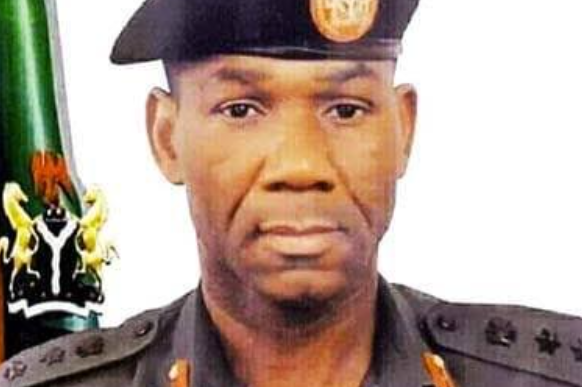
Brigadier-General Augustine Aniebo — Biography
Retired Nigerian Army Officer | Military Administrator | Born March 23, 1950 | Umunze, Anambra State
Full Name: Augustine Aniebo
Born: March 23, 1950 · Umunze, British Nigeria (now Anambra State, Nigeria)
Age (2026): 76 years old
Nationality: Nigerian
Ethnicity: Igbo
Branch: Nigerian Army
Final Rank: Brigadier General
Allegiance: Federal Republic of Nigeria
Offices: Military Administrator of Borno State (1997–1998), Military Administrator of Kogi State (1998–1999)
Regimes: General Sani Abacha, General Abdulsalami Abubakar
Notable Daughter: Dr. Ifeyinwa “Ify” Aniebo Rhodes-Vivour (molecular geneticist, Associate Professor, IGH/ACEGID)
Son-in-law: Chief Gbadebo Rhodes-Vivour (Obalefun of Lagos, 2023 LP governorship candidate, Lagos State)
Origins — Umunze, Anambra State
Augustine Aniebo came into the world on March 23, 1950, in Umunze, a town back then in the Southern Region of British Nigeria, which is now part of Anambra State. Umunze sits in the southeast, in Orumba South Local Government Area — a place full of commerce and strong professionals. He was born seven years before Nigeria’s independence, so he grew up with the country itself, right as it was figuring out what kind of nation it wanted to be. The military became a fixture in that story, for better or worse.
He’s Igbo, one of Nigeria’s three main ethnic groups. That background made his assignments as a military administrator in Borno State and Kogi State — both far from Anambra geographically and culturally — pretty striking. Borno, up in the northeast, and Kogi, smack in the middle where the Niger and Benue rivers meet, are both complex, with multiple ethnicities and religions. Sending an Igbo officer from Anambra to run those states says a lot about how the military handled Nigeria; they mixed things up across ethnic lines. Sometimes that meant tension, but it also meant federal authority could cut through, and every once in a while, you saw real competence and fairness.
Military Career
Details about Aniebo’s earlier army days aren’t widely available, which is normal for officers who spent their careers in operational or administrative roles, not shouting from the rooftops in political or public positions. What stands out is he rose through the Nigerian Army and earned the rank of Brigadier General — the first general rank, kind of like a major general in other armies. His work life spanned the stormy times between the Biafran Civil War ending in 1970 and the return to civilian democracy in 1999.
He served during some of the most dramatic years in Nigerian history — Gowon, Murtala-Obasanjo, Shagari’s Second Republic, the Buhari coup, Babangida, the Shonekan interim stretch, Abacha, Abdulsalami, and then finally back to civilian rule. Army officers in those days weren’t just soldiers. They ran the country, filling roles that kept Nigeria running — like it or not, men in uniform were in charge.
A document from Canada’s immigration board in 1998, quoting Nigerian news, confirmed Aniebo as Lieutenant-Colonel at the start of his Borno posting in January 1997. He was promoted to Brigadier General either by the time he moved to Kogi or when he retired.
Military Administrator of Borno State — 1997 to 1998
Borno State sits at the outer edge of Nigeria’s northeast, touching Niger, Chad, and Cameroon. It’s sprawling, complicated, and sensitive. In 1997, Aniebo landed there as military administrator under Sani Abacha — the most iron-fisted of Nigeria’s military rulers. Abacha’s rule (1993–1998) was full of detentions, executions, and putting the squeeze on civil society. Military administrators didn’t have much autonomy, just central command and a mandate to follow Abuja’s orders.
Borno was tough. It was poor, mostly Muslim, layered with religious and ethnic complexity, and its borders were full of smuggling and constant movement. Two major events marked Aniebo’s time there.
The Church Crisis, May 1997: Right after Aniebo took charge, a big religious dust-up happened in Maiduguri, Borno’s capital. Security agents, supported by local Islamic leaders, stormed a Christian church and threw out the pastor and the congregation. Christian groups condemned the act, calling it discrimination backed by the state. Church leaders went straight to Aniebo, asking him to step in before the situation exploded into wider violence. The fact they reached out to him says people saw him as an administrator with real sway. What he did, and how far his involvement went, isn’t clear from records, but the event put him right in the middle of the tricky balance between religion, security, and politics in one of Nigeria’s most volatile states.
Anti-Smuggling Operations, 1998: Petroleum product smuggling across borders — into Niger, Chad, and Cameroon — was draining the economy and stealing from federal revenue. In 1998, Aniebo announced the Borno anti-smuggling task force was ramped up to clamp down on illegal fuel movement. Smuggling was a chronic headache in border states, fueled by Nigeria’s cheap, subsidized fuel and high prices just across the border. His announcement showed he understood the problem and was ready to use whatever tools he had to push back.
His stint in Borno lasted until August 1998, when he moved on to Kogi State. Lawal Haruna took over in Borno after him.
Military Administrator of Kogi State — August 1998 to May 1999
Kogi State sits at Nigeria’s heart, with Lokoja, its capital, right where the Niger and Benue rivers join. Kogi was formed in 1991 from chunks of old Benue and Kwara states, so it was pretty new when Aniebo got there. It was still wrestling with its identity and infrastructure. Ethnically and religiously, Kogi is a blend — Igala, Ebira, Okun, Ijumu, Bassa, Oworo, and more — no group dominates.
Aniebo took over as Kogi’s administrator in August 1998, following Colonel Bzigu Afakirya, and served under General Abdulsalami Abubakar, who stepped in after Abacha’s sudden death. Abdulsalami immediately set Nigeria on a fast track to civilian rule. Aniebo’s job in Kogi was pretty clear: keep things together and run them well while elections and handover worked out nationally. He wasn’t meant to overhaul the state — just manage the transition competently.
Aniebo Quarters, Lokoja: The clearest mark he left in Kogi is the Aniebo Quarters — a residential estate on Ajaokuta-Ganaja Road in Ganaja, Lokoja. The estate still stands and shows up on city maps and in local directories. Building it meant addressing housing needs in the growing capital, making a practical investment at a time when urban development was catching up with population.
He handed over power to Prince Abubakar Audu, the newly elected civilian governor from the PDP, on May 29, 1999 — the same day Obasanjo was sworn in as president. That day is now historic for Nigeria, the end of sixteen years of military rule and the launch of the Fourth Republic. Aniebo retired from the army right after, as was standard for outgoing military administrators.
The Two States in Context
If you look at both states Aniebo administered, the differences jump out. They’re opposites — and both are far from his own roots.
Borno: Far north-east, mostly Muslim, Kanuri-speaking, three international borders, famous as the seat of the old Bornu Empire. Kogi: Central, split among religions and ethnic groups, none dominant, built on the colonial history of the river confluence. Aniebo, an Igbo Christian from Anambra, ran both states in quick succession, under two different military heads of state, right when Nigeria was moving from dictatorship to democracy. That says a lot about the demands on senior officers under military rule, and it highlights his ability to work across Nigeria’s deep divisions — ethnic, religious, and geographic.
Family and Personal Life
Aniebo’s daughter, Dr. Ifeyinwa “Ify” Aniebo Rhodes-Vivour, is a standout molecular geneticist, researcher, and scholar. She’s currently Associate Professor of Molecular Biology and Genomics at the Institute of Genomics and Global Health (IGH), previously ACEGID, at Redeemer’s University in Nigeria. She’s got degrees from Queen Mary University of London, the University of Nottingham, two from Oxford, and the London School of Hygiene and Tropical Medicine, where she finished her PhD in 2018. She’s earned fellowships from the Gates Foundation, Aspen Institute, Harvard, and won The Future Awards Africa twice in 2010.
His daughter married Chief Gbadebo Rhodes-Vivour — architect, civic activist, traditional leader in Lagos, and Labour Party candidate for governor in Lagos in 2023. That family connection puts Augustine Aniebo, a retired Igbo general from Umunze, right at the intersection of Nigeria’s scientific elite, Lagos politics, and the tradition of forming multi-ethnic families despite Nigeria’s usual divides.
Legacy
At 76, Aniebo belongs to the last group of military officers whose careers hinged on the era of military rule. These men ran states, managed transitions, handled crises, built housing, and handed power over without becoming notorious like some of their peers. His name lives on — most directly — in the housing estate on Ajaokuta-Ganaja Road in Lokoja, and in his daughter’s remarkable scientific record. Both are legacies. One’s concrete, the other’s living. Neither needs him to keep making a difference.
Retired Nigerian Army Officer | Military Administrator | Born March 23, 1950 | Umunze, Anambra State Full Name: Augustine Aniebo Born: March 23, 1950 · Umunze, British Nigeria (now Anambra State, Nigeria) Age (2026): 76 years old Nationality: Nigerian Ethnicity: Igbo Branch: Nigerian Army Final Rank: Brigadier General Allegiance: Federal Republic of Nigeria Offices: Military…