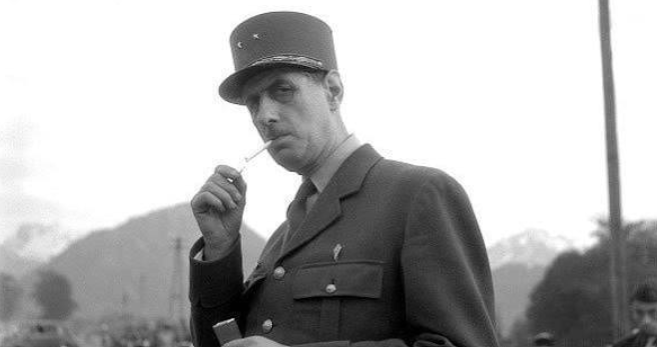
Charles de Gaulle (1890–1970) was a French general and statesman who led the Free French forces during World War II. He stands out as one of France’s most important twentieth-century leaders—he helped set up the Fifth Republic in 1958 and became its first President, holding office from 1959 to 1969. Fiercely conservative and an outspoken nationalist, de Gaulle’s political legacy lives on as Gaullism.
Charles de Gaulle Biography
Charles de Gaulle was born in Lille in 1890 to a conservative, deeply Catholic family—those beliefs stuck with him all his life and shaped his politics. He studied in Paris, then enrolled at the St. Cyr military academy. By 1913, he was serving in the infantry under Petain. In World War I, de Gaulle was wounded twice and saw heavy action around Verdun. The Germans caught him there in 1916; he spent the rest of the war as a prisoner, always plotting escapes that never worked out.
When peace returned, de Gaulle stayed in the army and got interested in new military strategies. He became convinced that future wars would depend on fast-moving, mechanized units—especially tanks, backed by air support. He laid out these ideas in his 1934 book “The Army of the Future,” but almost nobody listened. The French military clung to old methods, invested in the Maginot Line, and were wary of de Gaulle’s habit of ruffling feathers. He didn’t get many promotions, and he eventually fell out with Petain too.
The German Invasion
When Germany invaded France in 1940, de Gaulle finally got a chance to lead a tank unit. At Caumont, on May 28, his men briefly stalled the German advance—one of France’s few bright spots in those dark weeks. But without enough support, the French couldn’t hold. As the government teetered, Prime Minister Paul Reynaud made de Gaulle Minister of War for all of six weeks. Soon after, most leaders, including Petain, called for an armistice. That’s how Vichy France began.
De Gaulle wouldn’t accept defeat. He saw the armistice as a betrayal and made his famous June 18, 1940, broadcast:
“France has lost a battle, but France has not lost the war.… Whatever happens, the flame of the French resistance must not be extinguished and will not be extinguished.”
With a warrant out for his arrest, he fled to Britain and became the face of the Free French movement—at first, a voice in the wilderness. His radio messages weren’t heard by many in those early days. But as the shock of defeat faded, more people tuned in. Secretly, the French began passing his speeches around and finding encouragement.
“Let us be firm, pure and faithful; at the end of our sorrow, there is the greatest glory of the world, that of the men who did not give in.”
—Charles de Gaulle, 14 July 1943
Even with rivalries inside the French resistance—especially with the Communists—de Gaulle managed to pull the movement together by 1943. They agreed to uneasy cooperation until the liberation.
That year, de Gaulle set up a provisional government in Algeria—a move that annoyed the Allies, so the French were shut out of the initial D-Day invasion. But while Paris was being liberated, a small French force was allowed to take part. It boosted French pride and put de Gaulle and the Free French back in the picture.
After The War
In the postwar settlement, France was only included with the other major powers at the last minute—because de Gaulle pressed so hard for it. In 1945, he became head of the new government, but he resigned the next year out of frustration. He started his own party, the Rally of the French People, but it never really took off, and he retired.
France soon pulled him back. During the Algerian crisis in 1958, de Gaulle was recalled to power, wrote a new constitution, and became President again as the Fifth Republic began. Though he was a nationalist, he chose to let Algeria have its independence. Some of his old supporters felt betrayed and tried to kill him, but none of the attempts worked.
Back in charge, de Gaulle tried to stand apart from both the US and UK. He pulled France out of NATO’s command, developed nuclear weapons, and blocked the UK from joining the European Economic Community—twice.
The end of his presidency wasn’t steady. Massive student protests and riots shook France. In April 1969, de Gaulle stepped down. Just over a year later, on November 9, 1970, he died.
About the Author