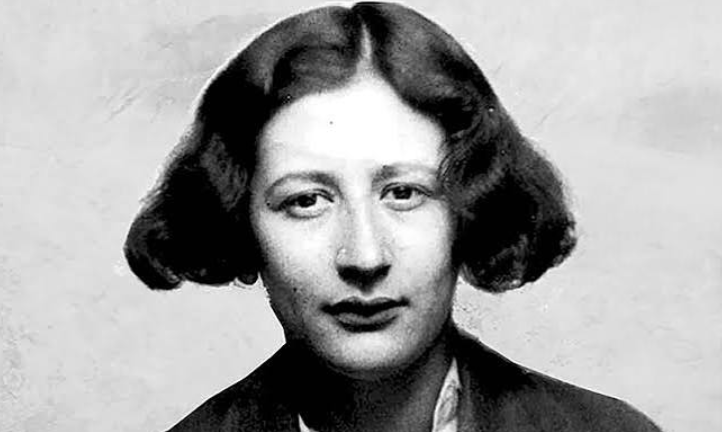
Simone Weil was a French philosopher whose life was marked by a raw, almost instinctive empathy for others. She wasn’t content just feeling the pain of the world—she rolled up her sleeves and tried to do something about it. Early on, she felt the pull of communism, hoping it would lift people up. But she never lost her critical edge. As the years passed, she grew wary of the way power can corrupt, even among those who promised liberation.
She hated injustice, but she also despised violence and war, swinging between pacifism and taking up arms herself. For someone raised by secular Jewish parents, it’s striking that her journey led her toward mystical experiences and a deep connection with Christianity. And yet, she never joined a church. To her, every major religion opened a path to the truth, and she saw no point in shutting out any of them.
Simone Weil Biography
Simone was born in Paris in 1909. Her family had roots in Alsace, a region that bounced between France and Germany. They were well-off, non-practicing Jews, not exactly embraced by mainstream France. When Simone came into the world, she was so fragile that doctors worried she wouldn’t last. Somehow, she pulled through, even after battling appendicitis as a baby. Growing up, she was a bright and stubborn child, gobbling up books and exploring big questions about God, politics, and justice. She had some quirks too—obsessing over cleanliness, avoiding germs and even shying away from physical contact, habits she never shook.
Simone always felt responsible for the suffering of others. Small things—like refusing her sugar ration during WWI when she heard about the hardships soldiers faced. And once, she and her brother decided to toughen themselves up by refusing socks in winter. Their mother saw in her a wild, untamable spirit—so stubborn that no one could sway her once she set her mind on something.
She dove into politics from an early age. By ten, Simone called herself a Bolshevik, itching to join protests for the unemployed. Still, her independence set her apart from the crowd. She challenged Marxism when others idolized it, wary that new leaders could simply replace old forms of oppression.
Education
Simone excelled at school, first at the prestigious Lycée Fénelon, then at the École Normale Supérieure. She outscored even Simone de Beauvoir in philosophy and logic. Somewhere along the way, she made a quiet vow to avoid romantic distractions and focus on helping the poor. She wasn’t interested in cultivating her looks or playing a part—plain clothes, direct speech, and little patience for small talk were more her style.
People noticed. She could seem aloof or even intimidating, with a tendency to see life in stark terms. She hated even small lies, and she held herself—and others—to high standards. De Beauvoir remembered their first meeting with a mix of annoyance and admiration. “It’s easy to see you’ve never gone hungry,” Simone said. The words stung, but left an impression.
After university, Simone became a teacher. She cared deeply about her students, often giving extra lessons for free. But her directness and criticism of the system made her a misfit in the classroom. She clashed with school authorities and moved from post to post, bringing on migraines that plagued her the rest of her short life.
Political activism
By 1932, as Europe’s politics spiraled, Simone traveled to Germany to meet with Communists. She quickly sensed that these groups weren’t ready for the storm of fascism on the horizon. When Hitler rose to power, she helped German leftists escape danger.
Back in France, when workers went on strike, Simone left her teaching job and worked in a factory, determined to understand the reality of working-class life firsthand. The experience crushed any illusions she’d had about modern industry, which she described as soul-crushing, cold, and inhuman—a place where people’s spirits dried up under constant pressure.
Simone also crossed paths with Leon Trotsky, offering him shelter while he was in Paris. Still, she didn’t hesitate to challenge him. Their conversations turned sour, and he criticized her later in public.
Religious experiences
Religion became more important to Simone as she got older. She was moved by the raw faith of Portuguese villagers singing in procession—something about their simplicity awakened a connection in her. She began thinking of herself as a Christian but remained wary of religious institutions. For Simone, the teachings of Jesus caught her deepest attention, especially “love your neighbor as yourself.” She studied Buddhism, Hinduism, and Judaism too, convinced that all religions could point toward the same ultimate reality. She didn’t believe in blending them together, though. People needed to immerse themselves in each faith fully to really grasp its heart.
Mystical experience in Assisi
During a visit to Assisi—at the church where St. Francis once prayed—Simone experienced something profound. Alone in that ancient chapel, she found herself kneeling for the first time and sensed a force bigger than herself. Later, she’d recall feeling as if Christ himself had entered her. Yet she also thought that reading about ancient Greece, India, and Egypt had prepared her for this kind of revelation.
When World War II broke out, Simone’s family fled Paris for Marseille. She embraced the Resistance, writing under a pen name and helping refugees get what they needed to survive. She also continued her spiritual search, connecting with Catholic thinkers but never joining a church. She believed suffering—her own and others’—could open the soul to truth. Pleasure, she thought, rarely taught us much. Suffering, on the other hand, was a source of real knowledge.
Even as her spiritual life deepened, Simone stayed engaged with the world around her. She wrote “The Need for Roots,” a book about how France could restore its moral and spiritual core after the trauma of war and displacement. She kept trying to persuade leaders like Charles de Gaulle, but he dismissed some of her ideas as wild or impractical.
In 1942, Simone and her family escaped Vichy France for the United States. She soon made her way to London, hoping to join the Resistance more directly, but her health had collapsed. Tuberculosis kept her in bed, but she refused to eat more than the strict rations given in occupied France—her way of sharing in her country’s suffering. In August 1943, heart failure finally stopped her. She was just 34.
Simone Weil left a strange and powerful legacy. Some admired her for her stubbornness and willingness to sacrifice, calling her a saint. Others bristled at her criticisms and uncompromising demands. Still, her writing and example shaped a whole generation of French thinkers. As one of her admirers said, “Simone Weil—she’s the only great spirit of our times. And nobody should try to claim her legacy for themselves.”
About the Author