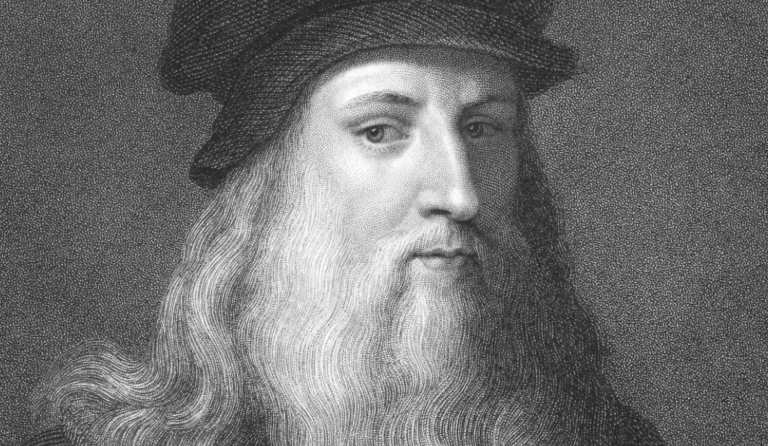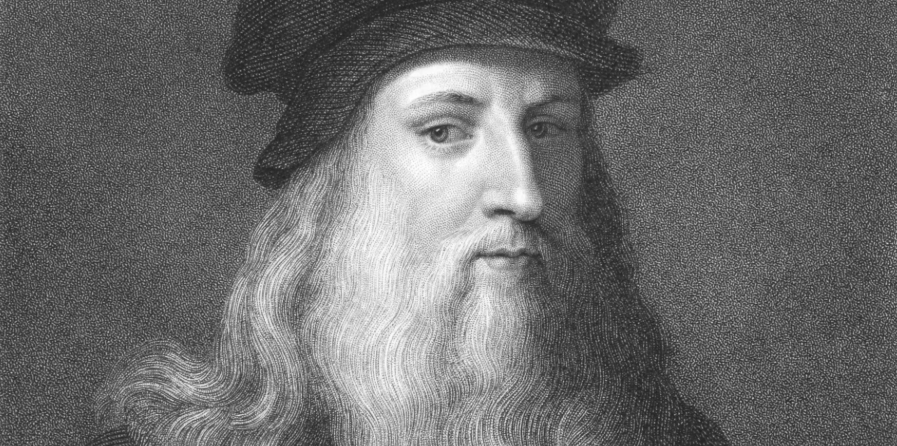
Leonardo da Vinci (1452 – 1519) stands out as one of history’s most brilliant minds. He chased perfection in everything he did, and that’s clear in masterpieces like ‘The Mona Lisa’ and ‘The Last Supper.’
But art was just one part of his story. Da Vinci’s curiosity spilled into everything—anatomy, math, astronomy—you name it. He wasn’t just after answers; he wanted to see how all things connect. People see him as a key figure in launching the European Renaissance, that wild era when new ideas, scientific breakthroughs, and stunning art exploded onto the scene.
Leonardo’s Story
He was born out of wedlock—a nobleman’s son and a peasant’s boy—in Vinci, Italy. Even as a kid, he loved nature, and his sharp mind and artistic talents showed up early.
In 1466, Leonardo landed in Florence and entered Verrocchio’s workshop. At first, his painting style mimicked his teacher’s, but he quickly broke away, forging his own bold path. His first major commission, “Adoration of the Magi” for the monks at San Donato a Scopeto, never made it to completion, but it introduced ideas nobody had seen before: a real sense of motion, drama, and the sharp contrasts of light and shadow known as chiaroscuro—a style he’d later perfect in the Mona Lisa.
He put it plainly: “Shadow is the means by which bodies display their form. The forms of bodies could not be understood in detail but for shadow.”
In 1482, Leonardo headed to Milan and served under Ludovico Sforza for 16 years, painting and branching out into engineering and anatomy. He painted the unforgettable “Madonna on the Rocks” and “The Last Supper” while in Milan.
And “The Last Supper?” People call it one of the greatest religious paintings ever. At its center, Christ sits, ready to reveal his betrayal by Judas. The emotion is raw and real. Sadly, time hasn’t been kind to the original painting, despite many restoration attempts—it’s faded, cracked, and worn.
The “Mona Lisa” Years
When Sforza lost power in 1499, the French invasion pushed Leonardo back to Florence. There, he took on “The Battle of Anghiari”—an ambitious fresco that inspired artists for generations, even though it was left unfinished and later destroyed. But it was here that he painted the Mona Lisa—the portrait of a nobleman’s wife whose fleeting, mysterious smile would capture the world forever. Legend has it Leonardo tried everything to get her to smile, hiring musicians and more, but nothing worked. One day, she granted him a faint, enigmatic smile for just a moment, and he caught it.
Art critics, poets, and thinkers have debated her smile for centuries. Sri Chinmoy captures it best: “That smile has immortalized her, immortalized the artist and immortalized the art. A smile that has an enigmatic touch… that soul-touch has conquered the heart of the world.”
With the Mona Lisa, Leonardo nailed his two favorite techniques—sfumato’s gentle color transitions, and the drama of chiaroscuro’s light and shadow.
But painting wasn’t enough for him. Leonardo threw himself into studies of engineering, science, and anything else he could get his hands on. He filled his notebooks with sketches, always in his backward “mirror” handwriting, much of which nobody could even read while he was alive. He sketched elaborate machines—like helicopters and flying devices—centuries before they’d actually be built. He loved birds, sometimes buying them just to set them free. And his medical notes? If people had read them sooner, they might’ve changed science itself. He figured out the circulation of blood before anyone else and realized the earth revolves around the sun, way ahead of Copernicus and Galileo.
Leonardo believed everything fit together. He once wrote: “Here forms, here colours, here the character of every part of the universe are concentrated to a point…”
He saw the universe as one, and he believed in people’s potential to grow and innovate.
Then there’s his famous drawing, the “Vitruvian Man.” It blends art, science, and a love of human form, inspired by the ancient Roman architect Vitruvius. Just a simple line drawing… but it’s become an icon of harmony and proportion.
Though Leonardo’s fame grew during his lifetime, he wasn’t wealthy. He survived thanks to powerful patrons, like Cesare Borgia, who in the early 1500s demanded weapons—crossbows, tank prototypes, even machine guns.
Personal Life
Leonardo never married or had children. He kept his private life close to the chest and poured his energy into his art and endless investigations. He grew close to a handful of pupils, especially Salai and Melzi, but most of the time he lost himself in his work. Those who met him talked about his striking looks, calm presence, and strong sense of right and wrong. Da Vinci prized truth more than anything else: “To lie is so vile, that even if it were in speaking well of godly things it would take off something from God’s grace; and Truth is so excellent, that if it praises but small things they become noble.”
His first biographer, Giorgio Vasari, wrote of him: “There was an infinite grace in all his actions; and so great was his genius, and such its growth, that to whatever difficulties he turned his mind, he solved them with ease.”
Leonardo respected all living things. He became a vegetarian and was known to buy caged birds only to release them. He once said, “The time will come when men such as I will look upon the murder of animals as they now look upon the murder of men.”
Between 1506 and 1510, Leonardo worked in Milan for the generous French King Louis XII. In 1513, he traveled to Rome, where he enjoyed the support of Pope Leo X. He worked alongside other legends—Michelangelo and Raphael—but it wasn’t without tension. Michelangelo, especially, locked horns with him.
Religion
Da Vinci didn’t fit the mold of an orthodox Catholic. Vasari put it this way: “[His] cast of mind was so heretical that he did not adhere to any religion, thinking perhaps that it was better to be a philosopher than a Christian.”
About the Author