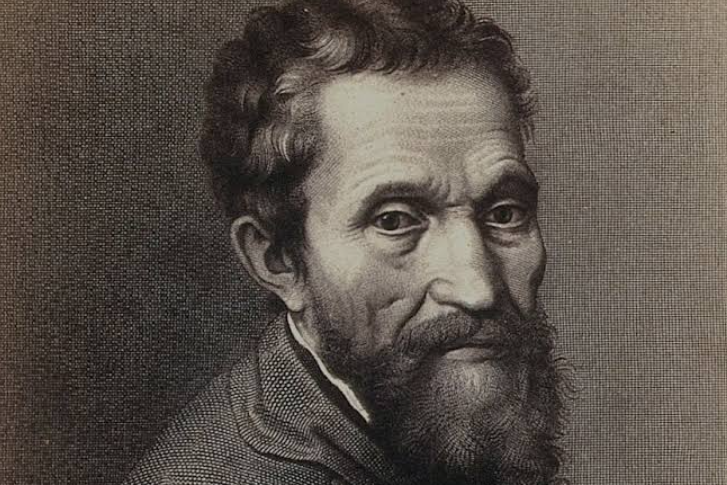
Michelangelo (1475–1564) was an Italian Renaissance sculptor, painter, poet, and architect. His talent and vision left a permanent mark on Western art, and you’ll find his influence everywhere—just think of the Statue of David, The Pietà, or his astonishing Sistine Chapel ceiling in the Vatican.
Early Life
He was born Michelangelo Buonarroti on March 6, 1475, in the village of Caprese near Florence. His father was a magistrate and came from a respected Florentine family, which made Michelangelo’s interest in art stand out. Back then, art wasn’t exactly the noble career path his family hoped for, but Michelangelo wasn’t swayed. At thirteen, he became an apprentice to Domenico Ghirlandaio, Florence’s top fresco painter. That’s where Michelangelo picked up the basics of painting, but even then, he gravitated toward sculpture. He saw sculpting as a way to breathe life into stone, something painting couldn’t quite capture for him.
It didn’t take long for people to notice his gift. Lorenzo de’ Medici, the most powerful man in Florence, brought Michelangelo into his circle. At the de’ Medici court, Michelangelo learned from the masters and soaked up a broad education. He even joined in anatomical dissections to understand how muscles and the human body worked—not something every artist of the time bothered with. Michelangelo’s ambition was clear: not just to match the great Greek and Roman artists, but to surpass them.
The Pietà
Florence was the epicenter of the Renaissance, and Michelangelo was in the thick of it. The city was bursting with creative energy, but also going through its share of upheaval. His first patrons, the de’ Medici family, were forced out of power, so Michelangelo looked elsewhere for work. In 1496, he moved to Rome, where a French cardinal named Jean Bilhères commissioned The Pietà. That sculpture—Mary holding her crucified son—was so powerful and moving that word of Michelangelo’s talent spread fast.
If you visit St. Peter’s Basilica in Rome, you can still see The Pietà today.
Soon after, back in Florence, Michelangelo turned his attention to a giant slab of marble that had been ignored for years. From that awkward block, he carved David—a masterpiece of human form, smooth as silk, without a hint of chisel marks. People marveled at his ability to coax life out of rough stone; Michelangelo once said he just set the figures free from the marble.
“I saw the angel in the marble and carved until I set him free,” he said.
Michelangelo’s talent put him in the same league as his contemporary, Leonardo da Vinci, but the two didn’t get along. Both were stubborn, both geniuses, and when Florence asked them to decorate opposite walls of a chamber, neither finished the job. They just couldn’t collaborate.
Pope Julius II
In 1505, Pope Julius II called Michelangelo to Rome, at first with a grand plan: build his tomb. That project stalled—money and attention shifted to rebuilding St. Peter’s—but eventually Julius handed Michelangelo a new challenge: paint the Sistine Chapel ceiling. Michelangelo started this massive work in 1508. He chose Old Testament stories rather than the New, and for four years, he painted lying on his back in grueling conditions. Paint dripped onto his face, his neck ached constantly, but he pressed on, refusing to let assistants help. He wanted the ceiling to be his alone.
“If you knew how much work went into it, you would not call it genius,” he once said.
When it finally revealed, people were stunned. Almost 300 figures, scenes from the Creation to the Flood to the Fall of Man—Pope Julius included—stood in awe. Michelangelo’s reputation soared; he became known as “the divine Michelangelo,” a title he didn’t mind in the least.
“The greater danger for most of us lies not in setting our aim too high and falling short, but in setting our aim too low and achieving our mark,” he said.
Later on, Michelangelo returned to Florence and got tangled up in politics, helping defend the city from the returning de’ Medici family. After they reclaimed power, his fame protected him—he was simply given more art to create. By 1546, he was chosen as chief architect for a new St. Peter’s in Rome.
As he aged, Michelangelo’s work grew more reflective, shaped by his deepening religious feelings. You can see that honest spiritual struggle and aspiration in his later poetry and art. For him, every masterpiece was a shadow of something divine.
“The true work of art is but a shadow of the divine perfection,” he believed. And really, looking back on Michelangelo’s life, it’s tough to disagree.
About the Author