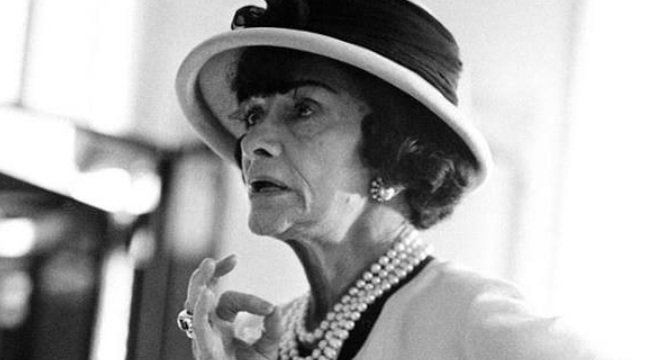
Gabrielle Bonheur “Coco” Chanel (August 19, 1883 – January 10, 1971)
“Fashion isn’t just about dresses. It’s in the sky, in the street—fashion is about ideas, the way we live, what’s happening.”
– Coco Chanel
Coco Chanel changed everything about how women dress. She stripped away the fuss and replaced it with clean lines and a new kind of elegance. When Time made their list of the 100 most influential people of the twentieth century, Chanel was the only designer to make the cut.
Coco Chanel Biography
The 1920s belonged to Chanel. Back then, women’s clothes were heavy and awkward—full-length skirts that dragged on the ground and got in the way. Chanel decided women deserved something better. She made clothes that were practical and stylish. She put women in suits and trousers for the first time.
“Fashion has become a joke. Designers seem to have forgotten there’s a woman inside the dress. Most women dress for men and want to be admired, but they also need to move, to get into a car without tearing their seams! Clothes should follow the body’s natural shape.”
– Coco Chanel
She also gave the world Chanel No. 5, a fragrance that’s now a legend itself.
Chanel didn’t come from privilege. She was born Gabrielle Chanel in 1883, but she didn’t like to talk about her age or childhood. Her mother was unmarried, and life was hard. When she was 12, her mother died. Chanel’s father sent her and her sisters to a convent in Corrèze. It was strict, but she learned to sew there, and that skill shaped everything that followed.
When she turned 18, Chanel left the convent and moved to Moulins. She found work as a seamstress and tried to launch a singing career in cabarets. She sang, but her voice didn’t open doors. Around 1908, she met Étienne Balsan, a wealthy aristocrat. That relationship pulled her into a new world and a different social scene.
By 1913, with financial help from another lover, Arthur Capel, Chanel opened her own boutique in Deauville. She chose jersey fabric—a practical choice during the shortages of World War I. She earned a reputation for leading women’s fashion, and that first taste of success spurred her to open another store in Biarritz, a hot spot for the wealthy during the war.
By 1919, Chanel opened her first Paris boutique at 31 rue Cambon—the heart of Parisian fashion.
“In 1919 I woke up famous. I never saw it coming. If I’d known, I might have run away and cried. I was stupid, or maybe just too sensitive.”
– Coco Chanel: Her Life, Her Secrets (1971), p. 95
After the war, Chanel wanted to reinvent women’s fashion yet again. She tossed out corsets and gave women a wardrobe that was both elegant and easy.
“With a black sweater and ten rows of pearls, Chanel revolutionized fashion.”
– Christian Dior
The roaring twenties brought change for women—votes, jobs outside the home, a taste of freedom. Chanel’s designs were at the center of all that. She created the collarless cardigan jacket, the bias cut dress (everyone wanted one), the shoe-string strap, the floating scarf, and a mix of fine and costume jewelry.
In 1938, she stepped back, frustrated by the male-dominated world of French fashion. But sixteen years later, she came roaring back. Critics hated her comeback line, but the public loved it. Once again, the rich and famous copied her style.
“In order to be irreplaceable, one must always be different.”
– Coco Chanel
She trusted her own taste. She understood what people wanted, and she married practicality with looks. That’s how she became the most recognized name in fashion.
Chanel didn’t just stop at clothing. She created a line of stylish jewelry that mimicked high-end pieces—so wealthy women could leave their real gems at home.
Then came the famous bag. In 1929, she designed her iconic handbag, made with a slim strap so a woman could keep her hands free. She updated it in 1948, and it became the legendary Chanel 2.55.
World War II turned everything upside down. In 1939, Chanel shut her shops, saying there was no place for fashion during war. Three thousand workers lost their jobs—partly over ongoing disputes about pay and conditions.
During the German occupation of Paris, Chanel became involved with a German officer, Hans Günther von Dincklage, and lived in luxury at the Ritz. Her politics were controversial—she made no secret of her anti-Semitism and sympathy toward some aspects of the German cause. Biographer Hal Vaughan later uncovered documents pointing to Chanel’s involvement with SS intelligence, working for General Walter Schellenberg. After the war, she took care of Schellenberg’s medical bills.
Other files suggest the Nazis tried to use Chanel as a courier to broker a peace deal with Churchill and the Allies. That plan went nowhere.
Chanel was questioned in 1944 about her wartime activities, but there wasn’t enough evidence to charge her. Some say Winston Churchill himself helped make sure she wasn’t put on trial, worried that her testimony would embarrass people at the highest levels.
After the war, Chanel spent time in Switzerland and didn’t return to Paris until 1954. Meanwhile, Christian Dior and other male designers eclipsed her brand in France. But her comeback worked in Britain and the US, even as she struggled to win back her home country—many still judged her wartime choices.
Chanel never married or had children, but she had her share of high-profile relationships, including poet Pierre Reverdy and designer Paul Iribe. Biographers have said she was always something of a mystery—full of contradictions, her true motives hard to pin down.
“Despite the work of a dozen biographers… Chanel remains an enigma.”
– David Downie, Paris, Paris: Journey Into the City of Light (2005)
She died at 87, at the Hotel Ritz, where she’d lived for more than 30 years.
In the 1960s, they even made a Broadway musical about her life, with Katharine Hepburn playing Chanel. The irony? Chanel probably would have hated all the fuss—she always liked to keep people guessing.
About the Author