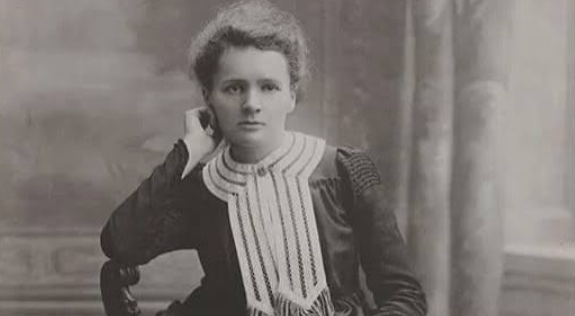
Marie Curie (1867–1934) broke new ground in science—and she did it twice over. Born in Poland, she went on to win Nobel Prizes in both Chemistry and Physics. Her groundbreaking research made it possible to isolate radioactive isotopes for the first time. She discovered polonium and radium, and during World War I, she found a practical use for X-rays on the battlefield. Curie faced relentless discrimination as a woman in science but kept going. She became the first female professor at the University of Paris, opening doors for other women in research.
Marie Curie Biography
“Humanity needs practical men, who get the most out of their work, and, without forgetting the general good, safeguard their own interests. But humanity also needs dreamers, for whom the disinterested development of an enterprise is so captivating that it becomes impossible for them to devote their care to their own material profit.”
—Marie Curie
Marie Curie was born Marya Sklodowska on November 7, 1867, in Warsaw, Poland. She grew up as the youngest of five kids, in a family that was poor but valued education above almost everything else. Marya shone at school and won prize after prize. Early on, she wanted more than just knowledge—she dreamed of a free Poland, independent from Russian rule. At the time, Russia made life especially hard on intellectuals—and it was even worse for women, who weren’t allowed much education at all. Marya wanted to teach Polish women, so they’d have a shot at learning too.
She was unusual for her time, especially as a girl interested in Chemistry and Biology. But Poland offered almost no opportunities for advanced study, so Marya left for Paris. She worked as a governess until she could afford the Sorbonne. Studying in French was tough, but she threw herself into her work, living simply and focusing on school. Her dedication paid off. She graduated first in her class in Physics, then earned another degree in Mathematics, finishing second. Curie’s drive for hard work never seemed to run out.
“Life is not easy for any of us. But what of that? We must have perseverance and above all confidence in ourselves. We must believe that we are gifted for something, and that this thing, at whatever cost, must be attained.”
Paris is where she met Pierre Curie, head of the lab at the School of Physics and Chemistry, an accomplished scientist in his own right. Pierre quickly fell for Marya and proposed. She turned him down at first, but his persistence won her over. They became inseparable, in both science and life, working together in the lab and spending their off hours traveling and cycling around Europe.
Marie plunged into research on radioactivity—a word she actually coined. In 1898, the Curies discovered two new elements: polonium, named for her homeland, and radium. The two of them spent years painstakingly extracting a tiny amount of radium from tons of uranium ore. They learned radium could burn skin and, oddly enough, had the power to destroy diseased cells in the body—a discovery that led to the beginnings of radiotherapy, known then as “curietherapy.”
Instead of keeping their discovery secret or seeking a patent, the Curies chose to share their findings with the world. Soon, radium was in high demand, and mass production began. Their work earned them the Davy Medal in Britain and, in 1903, the Nobel Prize in Physics—making Marie Curie the first woman ever to win a Nobel.
Then, tragedy hit. Pierre died in a road accident in 1906. Marie was left to raise their daughters, Irène and Ève, while running the laboratory on her own. Irène would later win her own Nobel Prize in Chemistry.
The Nobel Prize
In 1911, Marie Curie won a second Nobel Prize, this time in Chemistry, for her work with actinium and further studies on radium and polonium. Despite her success, she faced backlash and gossip from jealous, male colleagues who resented her achievements.
When World War I broke out, Marie stopped her research to focus on helping wounded soldiers. She realized X-ray machines could make a huge difference in treatment. She led the installation of X-ray units in hospitals and personally trained doctors in their use. By the end of the war, over a million soldiers had been examined with her machines.
After the war, Curie went back to the Radium Institute in Paris, wrote a book called “Radiology in War,” and joined the League of Nations’ International Commission for Intellectual Cooperation. She believed deeply in the value of international collaboration, despite its challenges.
“I believe international work is a heavy task, but that it is nevertheless indispensable to go through an apprenticeship in it, at the cost of many efforts and also of a real spirit of sacrifice: however imperfect it may be, the work of Geneva has a grandeur that deserves our support.”
—Letter to Ève Curie (July 1929)
She was known for being modest and living with few luxuries. She even asked for her prize money to be given to research, not herself. During the war, she offered her Nobel Prizes to the French treasury to fund the war effort.
Marie Curie died of cancer in 1934—a sad irony, since her own research on radioactivity had paved the way for cancer treatments but exposed her to the dangers she couldn’t fully predict.
Her legacy isn’t just in the new elements or the medical breakthroughs she enabled. Curie broke barriers for women in science and set new standards for achievement, proving both women and men could change the world. Her work laid a foundation for future research—Ernest Rutherford’s atomic model, advanced cancer therapy, and more. And her courage inspired generations to fight for a place in scientific discovery.
About the Author