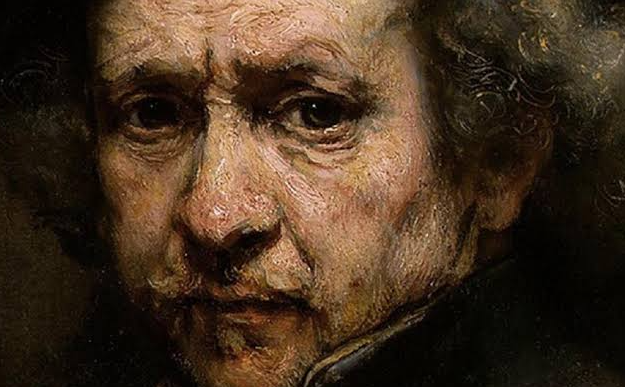
Rembrandt Harmenszoon van Rijn (1606–1669) was one of the true giants of art—a Dutch master unlike any other. Vincent van Gogh called him a magician, someone who could say things with paint that words just can’t touch.
Rembrandt Biography
Rembrandt’s story starts in Leiden, Netherlands in 1606, right in the middle of the Dutch Golden Age. His family had a bit of money—his father ran a mill, and it was enough to send young Rembrandt to a Latin school and then to the University of Leiden. But the classroom never really grabbed him. What stuck with him, though, was all the scripture he read—he’d use that depth of knowledge later, when he brought biblical moments to life on canvas.
Rembrandt left the university and started an apprenticeship in painting back in Leiden. In 1624, he headed to Amsterdam to learn from Pieter Lastman, who was well-known at the time. With some new skills and confidence, Rembrandt set up his own workshop in Leiden.
In 1629, things really started moving. The influential Constantijn Huygens noticed Rembrandt and helped land him commissions from the Court in The Hague. That was big—since the Protestant church wasn’t supporting artists like the Catholic church had, these court commissions kept Rembrandt going.
His career took off. By 1631, he set up shop in Amsterdam, the heart of Dutch life. He married Saskia Van Uylenburg, who came from a well-off family, and that brought some financial stability. Rembrandt began teaching students and joined the Guild of Painters. For a while, life looked golden.
Tragedy
But tragedy wasn’t far behind. Three of Rembrandt and Saskia’s four children died at a young age. Then, after just ten years together, Saskia died too—only 30 years old. These losses cut deep. You can see the pain—and the raw humanity—in Rembrandt’s work from this period. He painted powerful, intimate scenes around Saskia’s death, and those canvases carry an understanding of human emotion that’s hard to match.
He found companionship again with Hendrickje Stoffels, his former maid. They had a daughter, but Rembrandt never remarried. There were financial reasons—remarrying could’ve cost him Saskia’s inheritance, so he left things as they were.
At the peak of his fame, Rembrandt bought a large house in the Jewish quarter of Amsterdam, stretching himself with a 13,000-guilder mortgage. He didn’t handle money well—he spent freely, especially on art and unusual props for his paintings. Soon enough, things started to unravel. In the 1650s, the Dutch economy slumped, commissions dried up, and Rembrandt couldn’t pay his debts. He filed for bankruptcy—carefully sidestepping jail—and ended up dying with almost nothing. Friends paid for his funeral.
Painting Is Life
Painting was everything to Rembrandt. He insisted on working in silence, hated interruptions, and even said he wouldn’t pause for a king if he was painting. He never went to Italy to see the old masters—unlike a lot of his peers, he felt he could learn all he needed just by paying attention to the world around him. “Choose only one master—Nature,” he wrote.
Still, he was tuned in to the changes of his time. Like Caravaggio, Rembrandt used dramatic shadow and light—chiaroscuro—to bring tension and emotional depth to his faces. His portraits aren’t just likenesses—they feel alive, with minds and feelings working behind the eyes.
Rembrandt once wrote that his goal was to capture “the greatest and most natural movement”—he meant the pulse of real emotion, the reason his paintings took time. His devotion shows in works like “Christ in the Storm on the Lake of Galilee” or “The Entombment of Christ,” where everything is about the human experience, right down to the smallest gesture.
He wasn’t just a painter—Rembrandt produced hundreds of etchings too, always chasing that sense of life moving through his subjects. He stayed true to himself, even when it cost him. In the end, his real legacy isn’t the money or the commissions. It’s the way he captured people—their pain, hope, and dignity—that still feels honest centuries later.
About the Author