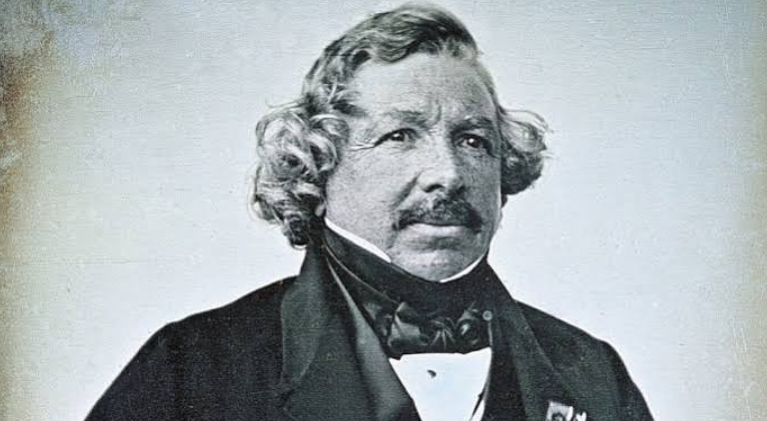
Louis Daguerre (1787–1851) was a French artist, printmaker, and inventor—and let’s be real, he’s the guy who really kicked off modern photography. His invention, the daguerreotype, is what gave us the first real step toward today’s cameras. It’s often marked as the moment photography was truly born.
He once said, “I have seized the light! I have arrested its flight! The sun himself in future shall draw my pictures!” This was back in 1835, and it’s easy to see the excitement oozing from those words.
Louis Daguerre Biography
Daguerre grew up in Cormeilles-en-Parisis, France, born November 18, 1787. As a young man, he apprenticed with a landscape painter, picked up some tricks in architecture and theater design, and worked as both a tax officer and scene painter at the opera.
His theater experience really paid off when he developed the Diorama—a dramatic showcase that mixed painting with clever lighting effects. When he first unveiled it in Paris in 1822, critics couldn’t get enough. The Diorama became the hot ticket in the 1820s and actually made Daguerre a decent living, even though his London venue burned down in 1839.
By 1829, Daguerre started dreaming about capturing permanent images—actual “photographs.” He teamed up with Nicéphore Niépce, who’d already made the world’s oldest surviving photograph. Together, they worked hard to fix images onto solid surfaces using light and chemicals. Niépce died in 1833, and for a while, Daguerre struggled on his own; not many people cared about his project. It wasn’t until 1838 that Daguerre felt ready to share his results.
He took his ideas to François Arago, a French statesman, who saw the potential and helped him get funding. The French government eventually gave Daguerre and his son pensions in exchange for the rights to his process—and in 1839, they released the secret to everyone, complete with instructions.
On August 19, 1839, Daguerre wowed the members of Académie des Sciences and the Académie des Beaux-Arts. He showed them how to create an image on a silver-plated copper sheet using iodine vapor, then develop it with mercury fumes, and finally fix it with salt water so the image wouldn’t change anymore. Early daguerreotypes needed to be sealed in glass to protect them, and the final image depended a lot on how the light hit it.
One of Daguerre’s biggest breakthroughs came by accident. In 1835, he noticed an almost invisible image on a plate he’d left in a chemical cupboard, and realized mercury vapors from a broken thermometer developed the image. That changed everything. Thanks to this method, exposure times dropped from eight hours to about thirty minutes, making the process much more practical.
People who saw the results were stunned. The images were so real, they felt almost magical.
Daguerre kept pushing forward. He photographed everything from dead spiders (which could help scientists study anatomy) to artistic still lifes and even took telescopic pictures of the moon. He saw photography’s potential for both science and art.
But just as things were taking off, disaster struck. On March 8, 1839—the same day he met Samuel Morse—his lab burned down, destroying his early experiments and notes. Still, his invention took off, spreading everywhere. Even with lots of technical limits, millions of daguerreotypes were made.
Inventions
Daguerre’s invention didn’t just change art; it changed life. Suddenly, newspapers could use real photos to tell the world about current events. The technique captured scenes from the American Civil War, the first photo of Abraham Lincoln, and even the Crimean War’s devastation. Regular people could finally afford to capture their loved ones’ likenesses, a privilege once reserved for the rich. And, of course, this led to motion pictures.
News about Daguerre’s process got across the Channel to Henry Fox Talbot in England, sparking him to resume his own work. Talbot’s approach used silver chloride paper and, in 1841, he introduced the calotype—a negative-positive process that allowed multiple prints from a single image. Talbot’s process competed directly, especially in Britain, where patent law meant Daguerre’s invention wasn’t quite as “free” as it was everywhere else.
In the following years, cameras got even better. New chemicals brought exposure times down to just seconds, and thanks to the Petzval portrait lens and Frederick Scott Archer’s collodion process, portrait photography and even motion images became possible.
Daguerre kept a record of his discoveries in memoirs and technical descriptions. He was made an officer of the Legion of Honour and his name is one of the 72 engraved on the Eiffel Tower.
In the end, it’s hard to overstate how much Daguerre’s work changed things—not just for artists and scientists, but for everyone. He took a wild idea and turned it into a reality, literally letting people “seize the light.”
About the Author