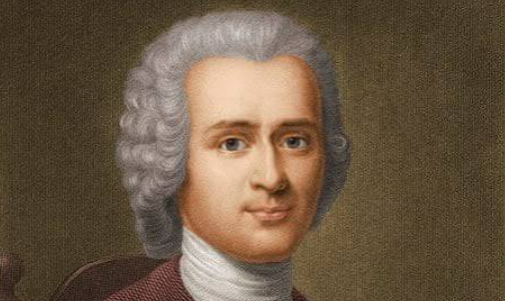
Jean-Jacques Rousseau shook up his world—and left a deep mark on ours. Born in Geneva but at home in Paris as much as anywhere, Rousseau wrote The Social Contract (1762), one of the central texts of political philosophy. In it, he argued for a more equal and just society, championing republican ideals that would echo through the French and American revolutions. Rousseau questioned just about everything: religion, politics, social norms, you name it. His outspoken views often got him in trouble—his books were banned more than once, and he had to keep moving from country to country to avoid arrest. Besides his writing, Rousseau loved music and nature. He didn’t easily fit in a box, and that restless spirit made him a key figure of the Enlightenment and even a forerunner of Romanticism.
Early Life
Rousseau was born June 28, 1712, in Geneva. His mother died of fever just days after his birth. Geneva at the time was a Calvinist republic, democratic on paper but really run by a handful of rich families. So from early on, Rousseau lived among political debates and conflicting ideas about what makes a good society. He spoke fondly of Geneva later, holding it up as a model for an ideal state.
His father was a clockmaker, but when Rousseau turned ten, his father went into exile, leaving Rousseau and his brother with relatives. His education was patchy: first at home, then as an apprentice to a notary and later to an engraver. Neither path suited him, though. One night, locked out after curfew, Rousseau just kept walking—right out of Geneva.
Conversion and Early Adventures
On the road, Rousseau crossed paths with Françoise-Louise de Warens, a larger-than-life Catholic noblewoman who had turned her back on Protestantism. She charmed and mentored young Rousseau, filling his days with music, philosophy, lively company, and books. She also became his lover. With her encouragement, Rousseau dug into music and studied philosophy and math.
By 1739, having inherited some money, Rousseau moved to Lyon and eventually Paris. In Paris, he met Thérèse Levasseur, a laundry maid who became his companion and, later, his wife. Rousseau admitted they had five children—heartbreakingly, all were left at orphanages, a choice he later deeply regretted.
Paris Years
In Paris, Rousseau found his intellectual circle. Working closely with Denis Diderot, he helped produce the Encyclopaedia—hugely influential, anti-clerical, and bold. Rousseau’s writing grabbed attention for its energy and passion.
He was also a talented musician and composer; he developed a new system of musical notation (which the Académie des Sciences found interesting but not compelling enough to accept). One of his operas, Le Devin du village, was a hit with King Louis XV. Rousseau could have landed a comfortable job as a court composer, but he found that kind of life hollow. He became more aware of the dangers of wealth and social status, comparing the luxury of French society with its deep inequality.
When Diderot was jailed for his writing, Rousseau began questioning society even more. On his way to visit Diderot in prison, Rousseau famously had a revelation: “Man is naturally good, and it is from these institutions alone that men become wicked.”
In 1750, Rousseau won first prize in a competition with his essay, A Discourse on the Sciences and the Arts. He argued that civilization—so proud of its progress—often corrupts humans instead of improving them. Many found his claim radical, even heretical. While it was common to criticize society, it was Rousseau’s insistence on the basic goodness of humans that really set him apart from the religious orthodoxy of his time.
Music Controversies
During the 1750s, a battle of operas broke out in Paris: Italian vs. French. Traditionalists loved their structured French opera, but Italian opera was different—passionate, rule-breaking, letting melody take center stage. Rousseau sided with the new Italian styles, not just because he liked the music but because he was drawn to anything that let art burst the chains of old rules.
Rousseau’s musical battles foreshadowed the Romantic movement to come: heart over tradition, spirit over systems. After his success, though, he turned back to philosophy, believing that was his real calling.
Shifting Beliefs and More Exile
Rousseau started drifting away from his Encyclopaedist friends. They leaned toward materialism and atheism, but Rousseau grew more spiritual, defending the soul and divine order.
In 1754, he returned to Geneva, left Catholicism, and became Protestant again. He was welcomed home as a literary star (he even passed off his lover, Sophie d’Houdetot, as his nurse).
Major Works
Julie, ou la nouvelle Héloïse (1761) was an enormous hit—a love story, a meditation on temptation and redemption, and a challenge to stuffy social norms. The novel’s emotional force hooked readers; it became the century’s best-seller and turned Rousseau into a superstar.
The Social Contract (1762) is packed with famous lines, like “Man is born free, and everywhere he is in chains.” In this book, Rousseau reworks his earlier criticisms of inequality. He attacks Hobbes’ idea of the social contract, which he sees as favoring the elite. Rousseau lays out something new: everyone should be free and equal under the law, giving up certain freedoms so that society as a whole can thrive. For Rousseau, the true meaning of liberty is following laws you set for yourself, together with others.
Emile, or On Education (1762), came out at the same time. Rousseau dives into how to raise children to remain good and unspoiled by society. He offered sharp criticisms of organized Christianity, arguing instead for a “natural religion”—a direct connection to God through one’s conscience and nature, not dogma. Rousseau’s claim that all religions can foster virtue—if practiced sincerely—lit a firestorm. Both Paris and Geneva banned the book and issued warrants for his arrest.
Rousseau on the Run
Chased out of France and unwelcome in Switzerland, Rousseau moved constantly. Voltaire, who disagreed with Rousseau on many points, respected his courage and invited him to stay—Rousseau didn’t accept. He finally landed in Prussia, guest of Frederick the Great, but angry local pastors soon drove him out. Eventually, he even tried moving to England, invited by David Hume, but that quickly turned sour—Rousseau grew suspicious and fell out with Hume, believing he was being conspired against.
In 1767, using a false name, Rousseau snuck back into France. Oddly, he was greeted with more warmth than suspicion. He lived in several places, wrote on botany, and worked on his Confessions—an open, sometimes raw autobiography. Though finished in 1770, it wasn’t published until after his death.
Later Years and Death
In 1776, a run-in with a dog left Rousseau concussed and, from there, his health worsened. Two years later, he died of a stroke. He was buried quietly, but in 1794 his remains were reburied in the Pantheon in Paris, near Voltaire.
Legacy
Just over a decade after his death, the French Revolution erupted. Rousseau’s ideas didn’t just hang in the air—they helped shape revolutionary ideals about equality and liberty. His talk of the “general will” inspired people but also got twisted by leaders like Robespierre, who used it to justify violence against dissenters.
Rousseau’s influence reached far, ending up in America, too. Thinkers like Thomas Jefferson drew on French Enlightenment ideas—including Rousseau’s.
All in all, Rousseau stood at the crossroads of the Enlightenment and Romanticism, insisting on the power of human feeling, authenticity, and a return to nature. In philosophy, music, politics, and literature, Rousseau’s restless search for truth keeps echoing, long after his lifetime of controversy and imagination ended.
About the Author