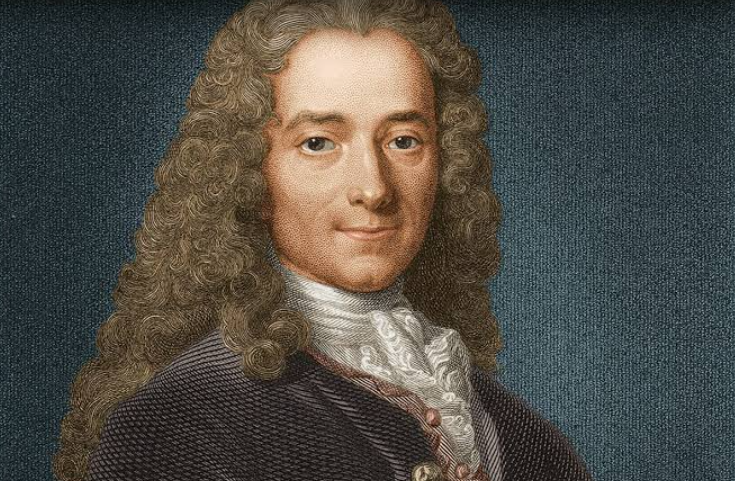
Voltaire (born François-Marie Arouet; 21 November 1694 – 30 May 1778) was a French writer, essayist, and philosopher famous for his sharp wit, biting satire, and unrelenting support for civil liberties. He threw himself into defending freedom of religion, freedom of thought, and political rights, making him a central figure during the Enlightenment.
“Love truth, but pardon error.”
– Voltaire
Voltaire Biography
He was incredibly prolific—he wrote more than 20,000 letters, plus over 2,000 books and pamphlets. Strict censorship laws didn’t slow him down much; he constantly challenged the authorities and took plenty of risks to do it.
Voltaire’s Story
Voltaire was born in Paris and grew up as François-Marie Arouet. Jesuits taught him at the Collège Louis-le-Grand, and he picked up Greek, Latin, and most of the major European languages along the way.
His father wanted him to become a lawyer, but Voltaire had other ideas. He loved writing, so he left law behind and got to work on poetry and sly critiques of the government and church. His sense of humor and sharp satire made him popular in Paris, though he also caught the eye of the censors, which meant trouble.
In 1726, a fight with a French nobleman got him exiled to England—the nobleman pulled some strings, had Voltaire arrested, and sent him off. The experience fired him up to push for changes in France’s legal system. After his stint in the Bastille, Voltaire ditched his old name and adopted “Voltaire,” marking a fresh start. Throughout his life, he kept using different pen names to dodge censorship.
His three years in England opened new doors. He studied British writers like William Shakespeare and learned about their government—a constitutional monarchy, not the absolute one back in France. He also studied great scientists, especially Isaac Newton. Voltaire admired the Scottish Enlightenment thinkers, such as Adam Smith and David Hume. He once said, “We look to Scotland for all our ideas of civilisation.”
Voltaire always had a complicated relationship with Jean-Jacques Rousseau. They had a lot in common but also plenty to argue about. But when Rousseau published Emile, attacking religious hypocrisy, Voltaire actually offered him refuge. Rousseau didn’t answer, a move he would later regret.
After he returned to France, Voltaire praised the British government’s approach to free speech in his letters. The French ruling class wasn’t happy, and he had to flee Paris once again.
Looking for safety, he started working with Marquise du Chatelet. He wrote about Newton’s theories, making complex science more accessible across Europe. Voltaire also started pushing hard for separation between church and state, religious tolerance, and freedom of belief. He wasn’t afraid to question the Bible, either. He never claimed a religion, but reason led him to believe in God.
“What is faith? Is it to believe that which is evident? No. It is perfectly evident to my mind that there exists a necessary, eternal, supreme, and intelligent being. This is no matter of faith, but of reason.”
In a letter to King Frederick II of Prussia, Voltaire wrote, “Ours [religion] is without a doubt the most ridiculous, the most absurd, and the most blood-thirsty ever to infect the world.”
Around 1744, Voltaire came back to Paris and started a lifelong relationship with his niece, Marie Louise Mignot.
He later accepted an invitation from Frederick the Great to come to Potsdam. Voltaire wrote scientific articles there but eventually fell out with the king after satirizing abuse of power.
His most famous work, Candide, appeared in 1759—a brilliant satire poking fun at the optimism of Leibniz. After a short stay in Geneva, Voltaire settled in Ferny near the French border for the next 20 years.
In his last years, Voltaire kept writing and supported religious minorities facing persecution. He met with leading thinkers like James Boswell and Adam Smith.
He died in 1778, not long after returning to Paris. Rumors swirled that he converted to Catholicism on his deathbed, but that’s still disputed.
Near the end, Voltaire wrote, “I die adoring God, loving my friends, not hating my enemies, and detesting superstition.”
He was buried in secret before any official statements could be issued. Three years later, in 1791, his remains were moved to Paris and honored at the Pantheon. It’s said that up to a million people came to pay tribute to Voltaire, now hailed as a hero and a forerunner of the French Revolution.
Voltaire’s Impact
Voltaire changed the way people wrote history—he tried to remove bias, focused on social and economic issues, and didn’t just list military events.
He pushed for better education, believing that literacy could help free people from ignorance.
He wrote plays, poems, and epic works, weaving politics and satire even into his romances. Sometimes, his indirect criticism landed the hardest blows.
Voltaire never stopped criticizing those who abused power, attacking the monarchy and church for their overreach. His efforts inspired a less deferential, more rebellious attitude in France—one of the roots of the French Revolution.
He spoke out when religious persecution was raging. Voltaire showed how dogma and ignorance fuel violence and suffering.
Above all, he was a key Enlightenment champion—always seeking to use reason and open minds to understand life, refusing to put his faith in any single book or doctrine.
A taste of Voltaire’s words:
“It does not require great art, or magnificently trained eloquence, to prove that Christians should tolerate each other. I, however, am going further: I say that we should regard all men as our brothers. What? The Turk my brother? The Chinaman my brother? The Jew? The Siam? Yes, without doubt; are we not all children of the same father and creatures of the same God?” (A Treatise on Toleration, 1763)
About the Author