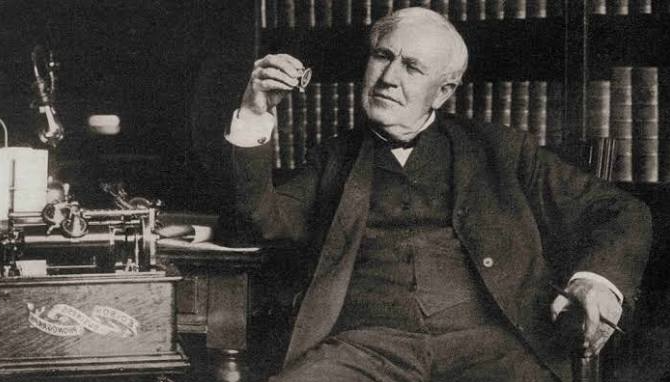
Thomas Alva Edison was one of those rare people who changed the shape of everyday life—and he did it over and over again. Not only did he invent things, he made sure anyone could get their hands on them. When he started the Edison Electric company, he found a way to bring DC electricity right into people’s homes and businesses. That was just one piece of it. The guy filed over 1,000 patents—electric light bulbs, the phonograph, the motion picture camera, even an early electric car and power stations. He wasn’t just tinkering for fun; he wanted his inventions to actually help people. He used mass production to keep prices low, so regular families could afford all this new tech.
Edison once said, “None of my inventions came by accident. I see a worthwhile need to be met and I make trial after trial until it comes. What it boils down to is one per cent inspiration and ninety-nine per cent perspiration.” He wasn’t exaggerating—he just worked harder and longer than most.
Short Biography Thomas Edison
Edison was born on February 11, 1847, in Milan, Ohio. He was the youngest of seven, and while his family had enough to get by, they weren’t wealthy. Things got tough when the railroad skipped Milan, and they had to move to Port Huron, Michigan. School? Well, that didn’t really suit him. He went for just three months before his questions and stubborn streak got on the teachers’ nerves. So, he mostly learned what he wanted, how he wanted—running through every book he could find in the library. By age 12, he’d devoured Newton’s Principia Mathematica but found it needlessly complicated. He decided right then that science should make sense.
Money was always tight, so young Edison hustled—selling candy, vegetables, newspapers, even printing his own newspaper on the Grand Trunk Railroad. He printed and sold pictures of Abraham Lincoln, his hero, and used the profits to buy chemistry supplies so he could experiment more.
Hearing Issues
He started to lose his hearing when he was young and grew almost completely deaf. But instead of seeing it as a setback, he just kept going. He once said medical treatment would be more trouble than it was worth, and deafness didn’t stop him from doing what he loved.
Edison’s life started to change when he saved a young boy stuck on a railroad track. The boy’s father taught Edison telegraphy, and soon after, he was off to Louisville, Kentucky, tapping out code for Western Union. His job gave him space for late-night experiments, but they weren’t all successful. One time, a lead-acid battery spilled sulfuric acid, burned through the floor, and dripped onto his boss’s desk. He lost his job the next day.
Instead of getting discouraged, Edison doubled down. Life was rough, but he put everything into invention. In 1869, he got his first patent—for the stock ticker—which made him a nice chunk of money. He sold his quadruplex telegraph to Western Union during the 1870s and earned $10,000. That was enough to set up a real lab, where he could get serious about inventing.
He always insisted that invention meant hard work and a ton of failed attempts. In his own words, “I have constructed 3,000 different theories in connection with the electric light, each one of them reasonable and apparently likely to be true. Yet only in two cases did my experiments prove the truth of my theory.”
The Wizard of Menlo Park
People first started calling him “The Wizard of Menlo Park” when he invented the phonograph in 1877. It amazed everyone—nobody had ever been able to play a recording of someone’s voice. Others eventually improved it, but he was the first to make it happen.
With help from William Joseph Hammer, Edison brought the practical electric light bulb to life. His breakthrough? A carbonized bamboo filament that burned for over 1,000 hours. In 1878, he formed the Edison Electric Light Company and predicted electricity would be so cheap that everyone would use it. He even built the very first power station in lower Manhattan. Suddenly, 59 customers had DC current running straight to their homes.
Edison’s workshop soon spread over two full city blocks, fully stocked with resources for any wild idea. That let him experiment on just about anything, anytime.
But things weren’t always smooth. He got tangled up in the so-called “current war” with George Westinghouse and Nikola Tesla (who actually worked for Edison a few years). Edison pushed for his DC system, while Westinghouse and Tesla argued for AC. The rivalry even got ugly, as Edison’s team staged animal electrocutions to “prove” AC was dangerous.
During World War I, the Navy asked Edison for help. He agreed but only designed defensive weapons, proud that nothing he created was made to kill. He believed that a truly advanced society was nonviolent—“Until we stop harming all other living beings, we are still savages,” he said.
Edison admired the Enlightenment thinker Thomas Paine and even wrote a book about him in 1925. Like Paine, Edison didn’t follow any mainstream religion; he just believed in a higher power.
He changed media too, inventing the Kinetoscope (the first simple motion picture viewer), helping launch film as we know it, and improving photographic paper.
Wife’s Passing
After his first wife, Mary Stilwell, died in 1884, he moved to West Orange, New Jersey. He remarried in 1886, this time to Mina Miller, and became friends with Henry Ford. He loved being part of the Civitan Club, helping out the local community. Even as he got older and his output slowed down, he kept experimenting—trying, for instance, to make a domestic source of natural rubber. In 1930, he worked on the first electric train out of Hoboken.
Edison cared about health too, and he often talked about how a good diet could change your life. His view was ahead of his time: “The doctor of the future will give no medicine, but will instruct his patient in the care of the human frame, in diet and in the cause and prevention of disease.”
He had six kids—three from each marriage—and he finally ran out of energy on October 18, 1931, dying from complications from diabetes.
Edison’s own words sum him up best:
“We don’t know a millionth of one percent about anything.”
“If we did all the things we are capable of doing, we would literally astound ourselves.”
“To invent, you need a good imagination and a pile of junk.”
“Just because something doesn’t do what you planned, doesn’t mean it’s useless.”
Or perhaps this: “Everyone steals in commerce and industry. I’ve stolen a lot, myself. But I know how to steal! They don’t know how to steal!”
He never thought much of politics, except that Thomas Paine—“our greatest political thinker”—set the bar and almost nobody has reached it since. Edison lived by his own stubborn, creative standards, and left a world wildly different from the one he was born into.
About the Author