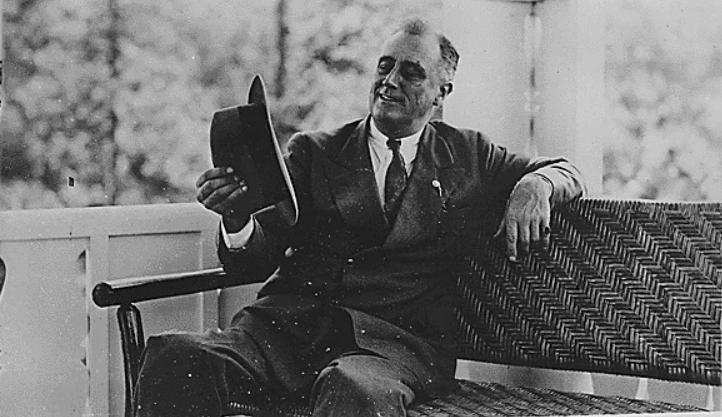
Franklin Delano Roosevelt, or FDR as most people called him, was the 32nd President of the United States. He ended up leading the country through the Great Depression and World War II—two of the roughest periods in American history.
Everyone knows that line: “The only thing we have to fear is fear itself.” He said that at his first inaugural address, and you can tell it really stuck with people.
FDR got elected right in the middle of the Great Depression in 1932 and stayed in office until his death in 1945. That’s rare—no one’s served as long as he did. During his time as president, the federal government grew in size and power, and the U.S. stopped sitting on the sidelines internationally. With Roosevelt leading, America helped defeat the Axis powers—Japan and Germany—and laid down the foundation for the United Nations right as the war ended. He wasn’t just a big deal in America; he changed a lot on the world stage, too.
Franklin D. Roosevelt Biography
FDR’s early years were pretty privileged. He was born in Hyde Park, New York, to a wealthy family and never wanted for much. Still, his headmaster at Groton, a prep school in Massachusetts, drilled into him that people with privilege had a duty to look out for those less fortunate. Later, he went to Harvard, studied economics, and edited the Harvard Crimson. He wasn’t a standout student, but he had a knack for managing people—the kind of skills you don’t always see on a report card.
In 1905, he married his distant cousin Eleanor, and they had six kids. Two of their children even made it to the House of Representatives. Their marriage wasn’t perfect—FDR had affairs, most famously with Lucy Mercer, his social secretary. At one point, Eleanor offered him a divorce, but that never happened. Still, when polio left FDR severely disabled, Eleanor stood by him and became both partner and nurse.
Roosevelt jumped into politics fast. He became governor of New York in 1929, which set him up to run for the presidency as the country was spiraling into economic collapse. Nearly 25% of Americans were out of work. People turned to FDR for answers, and he gave them hope. His New Deal wasn’t a magic fix, but it helped—a lot. The government put people to work, built roads, kicked off big projects, and helped protect workers. By the end of the 1930s, you could see some sectors, like construction, booming again. That was enough for people to give him a second term in 1936—and even a third in 1940, which broke tradition entirely.
Foreign Policy
On foreign policy, FDR wanted America more connected to the world, but most Americans wanted to keep their distance. In his 1940 campaign, he even promised to keep the country out of World War II, though it was clear he couldn’t stand what Nazi Germany was doing. Still, when Britain was alone against Hitler, Roosevelt pushed through the Lend-Lease program, saying helping was like lending a neighbor a hose when their house is on fire. Congress wasn’t exactly enthusiastic, but he got it done.
Everything changed after Pearl Harbor in December 1941. America jumped into the war, both in Europe and the Pacific. FDR proved sharp as Commander in Chief, picking leaders like Dwight Eisenhower and George Marshall—people who turned out to be big players in the Allied victory.
One thing people still talk about is Roosevelt’s fireside chats. He’d get on the radio and speak directly to Americans in plain, reassuring language, especially when things looked bleak. Those talks helped people feel connected to their president, like he was right there in their living room, guiding them through the storm.
Friendship with Churchill
He also built a strong friendship with Winston Churchill. The two of them, along with Stalin from the Soviet Union—the “Big Three”—put together a plan for the post-war world and got the United Nations started.
FDR’s life ended abruptly in April 1945—just before the first UN meeting. His death was a shock. People remembered him as a symbol of hope, optimism, and steady leadership.
When historians look back, FDR is almost always ranked as one of America’s greatest presidents. He steered the country through an economic disaster, helped defeat fascism, and pushed for policies that made sure the government would look out for its people. He built alliances in war, and when he took office in 1932, America was battered and isolated. By the time he died, the country had become the world’s powerhouse—economically, politically, and militarily—and FDR’s voice was the clearest and most powerful among the Allies.
About the Author