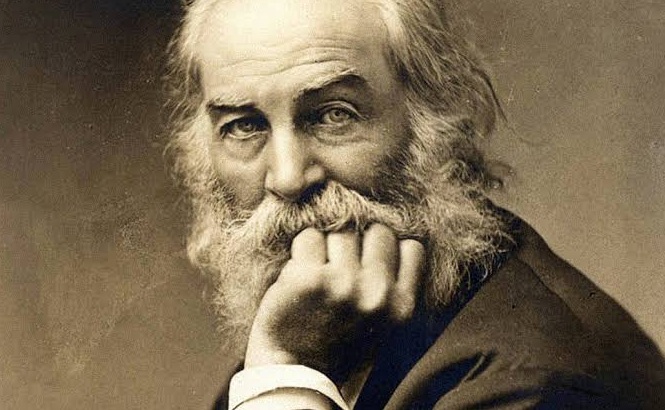
Walt Whitman was an American poet who bridged the gap between the Transcendentalists and the more down-to-earth poets of the twentieth century. His greatest work, Leaves of Grass, changed poetry forever with its bold, new voice.
Walt Whitman Biography
Walt Whitman was born on May 31, 1819, in West Hills, Long Island. He was the second of eleven children, with a father who worked as a carpenter and a mother named Louisa Van Velsor. Whitman grew up in Brooklyn and Long Island. By twelve, he was already learning the printing trade, and it wasn’t long before he fell in love with literature. He taught himself by reading everything he could get his hands on—Homer, Dante, Shakespeare, the Bible, you name it.
A massive fire in the New York printing district left Whitman out of work, so in 1836, at just seventeen, he became a teacher in the simple, one-room schoolhouses of Long Island. He taught until 1841, then shifted into journalism. He started his own paper, the Long-Islander, and edited several others around Brooklyn and New York. In 1848, he left the Brooklyn Daily Eagle to edit the New Orleans Crescent. While in New Orleans, he saw slavery up close and was horrified by it. He was against the spread of slavery, although he didn’t always side with the abolitionists, worrying they weren’t fully committed to democracy. Politics fascinated him and he watched it closely all his life.
The Brooklyn Freeman
Later that year, Whitman came back to Brooklyn and launched the Brooklyn Freeman, a Free Soil newspaper. Around the same time, he dove deeper into poetry and honed a style unlike anyone else’s. In 1855, he finished Leaves of Grass, a twelve-poem collection that introduced his new voice to the world.
I celebrate myself, and sing myself,
And what I assume you shall assume,
For every atom belonging to me as good belongs to you.
– Leaves of Grass, Walt Whitman
He published Leaves of Grass by himself, even sending a copy to Ralph Waldo Emerson, who led America’s literary thinkers at the time. Emerson was amazed.
About the Author