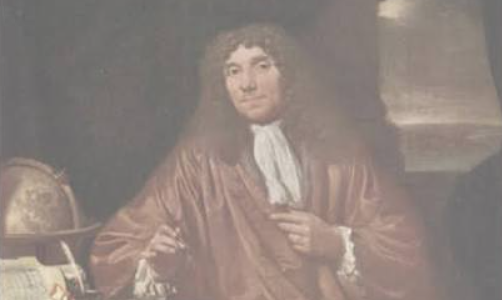
Antonie van Leeuwenhoek wasn’t trained as a scientist. He was a Dutch businessman from Delft who just happened to change the world. Born in 1632, a few days after the famous painter Vermeer—also in Delft—he got only a basic education. When he was 16, he moved to Amsterdam and spent six years learning the draper’s trade. By 1654, he’d moved back home, married Barbara de Mey, and managed to scrape together enough money to buy a house and shop. He made a living selling cloth and later picked up city jobs—first as a chamberlain for the Delft sheriffs, then as the official wine-gauger, keeping track of all the city’s wine imports.
Antony van Leeuwenhoek Biography
Life at home wasn’t easy. He and Barbara had five children, but only one, Maria, survived past childhood. Barbara died young, after just twelve years of marriage. He remarried, but his second wife, Cornelia Swalmius, had no children.
Working with cloth every day, van Leeuwenhoek grew frustrated with the poor quality of available magnifying lenses. He wanted to see fabric fibers up close—much closer than any existing tool could manage. So he started experimenting: heating glass, manipulating it, and through trial and error, he stumbled onto a method that let him make tiny, incredibly powerful lenses. Rather than share his technique, he decided to keep it a secret, giving himself a serious leg up. When visitors came calling, he hid his best lenses and put on a show, pretending he’d just ground the glass in the usual way. Over his lifetime, he made hundreds of these single-lens microscopes—some could magnify up to 275 times, which was jaw-dropping for the 1600s. He took his secret with him to the grave. Nobody figured it out until nearly 250 years later.
Life Through The Microscopes
He didn’t spend his evenings just counting money or chatting with city officials. Instead, he peered through his microscopes at everything he could find: water, insects, blood, skin, whatever caught his eye. Van Leeuwenhoek never thought of himself as a scientist—he always said he was just a curious businessman with a passion for discovery. But with encouragement from the physician Constantijn Huygens, he started writing to the Royal Society in London, then led by Robert Hooke. Huygens described him as “a modest man, unlearned both in sciences and languages, but… exceedingly curious and industrious.” That curiosity led to some wild discoveries, especially when he started finding entire living worlds invisible to the naked eye.
At first, scientists didn’t believe him. Single-celled creatures, bacteria, things no one had ever seen? It all sounded like fantasy to the old guard, so the Royal Society actually sent six independent observers to Delft to check his work. Sure enough, van Leeuwenhoek was right. That settled it—his discoveries were revolutionary, and he wound up elected to the Society in 1680, which surprised even him.
He approached his work with painstaking care, even as skeptics complained that an “amateur” without Latin or formal education couldn’t possibly be right. He only wrote in Dutch, never Latin, but sent his observations overseas for others to review. Despite mockery, he stuck with his methods—observation, repeatable experiments, and peer review—ahead of his time, honestly.
The Calvinist Faith
Van Leeuwenhoek followed the Calvinist faith, and in all that astonishing detail he saw under the microscope, he found evidence of God’s creativity and order. He wrote about “the unconceivable Providence, perfection, and order bestowed by the Lord Creator of the Universe upon such little creatures which escape our bare eye.”
He caught plenty of criticism. People called his observations “fairy-tales,” especially the French, who claimed those tiny animals weren’t real. Van Leeuwenhoek stood his ground, certain that the folks doubting him just didn’t know how to look closely enough.
One of his biggest breakthroughs was that he toppled the old idea of spontaneous generation. Before him, the thought was that small creatures—like fleas—just sprang up from nothing. But he proved they reproduced, just like larger animals. Over his life, he discovered infusoria (tiny aquatic life forms), bacteria, sperm, the vacuole in cells, red and white blood cells, even muscle fibers.
He never hunted praise. He once admitted, “My work… was not pursued in order to gain the praise I now enjoy, but chiefly from a craving after knowledge, which I notice resides in me more than in most other men.”
He lived to 90, which was remarkable back then. Royalty and famous scientists came to visit him in old age. But his greatest legacy? He opened up the microscopic world. It would take about two hundred years before science fully caught up and tied his discoveries to germ theory, but none of it would’ve happened without Antonie van Leeuwenhoek: the careful, stubborn, endlessly curious cloth merchant who changed how we see life itself.
About the Author