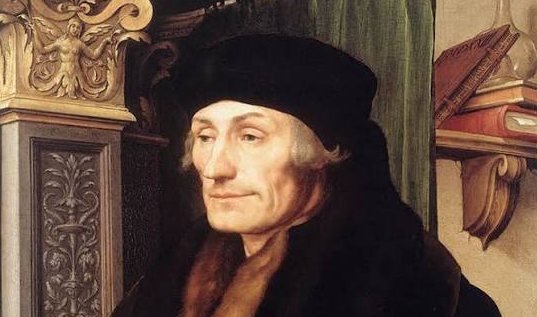
Desiderius Erasmus wasn’t your typical Renaissance scholar. He was Dutch, a Catholic priest, and a humanist who made some serious waves. Sure, he never officially joined the Protestant Reformation, but his sharp criticism of church practices cracked open the door for Luther and the others—even if he didn’t agree with the path they took. He stayed Catholic his whole life.
He once described himself like this:
“I am a citizen of the world, known to all and to all a stranger.”
Erasmus was famously devoted to scholarship. He turned down all sorts of cushy jobs so he could keep working on his own terms. He released new Latin and Greek versions of the New Testament and churned out book after book on all sorts of topics—becoming the most prolific author of his time.
Early life Erasmus
He grew up in Rotterdam, born in 1466 under less-than-ideal circumstances (his father was a priest, his mother was Margaretha Rogerius, and they weren’t married). His parents raised him until he was orphaned by the plague in 1483. He rarely talked about his youth—not surprising, considering the stigma of being born out of wedlock and his own embarrassment about it.
Erasmus got a monastic-style education, learning Latin and Greek at the ‘Brothers of the Common Life’ school in Deventer. By 1492, his guardians pushed him into taking monastic vows at Stein in Holland. He’d become a Catholic priest by 25, but honestly? He was never sold on the life. He didn’t stick to monastery rules and spent years criticizing the formal rituals he saw as empty gestures.
For him, faith came down to a personal connection with God and good behavior. In his book ‘Handbook of the Christian Soldier’ (1502), Erasmus hammered the point that rituals on their own are pretty hollow without real spiritual intent. He stressed that reading scripture is key—Christians should actually try to live like Christ.
He didn’t hold back when describing the state of some monasteries. In a letter from 1516, he wrote:
“There are monasteries where there is no discipline, and which are worse than brothels… There are others where religion is nothing but ritual; and these are worse than the first, for the Spirit of God is not in them, and they are inflated with self-righteousness.”
He was also open-minded about topics that made others squirm. Writing in Praise of Marriage (1519), he called out the people who acted like sexual feelings were something to be ashamed of—he thought that was nonsense.
Back in his Stein days, Erasmus wrote passionate letters to a fellow monk, Servatius Rogerus. Some historians debate whether that relationship was platonic or romantic. There’s no real evidence either way, but the letters were pretty heartfelt.
He was tireless in his studies. In 1495, he landed a job as secretary to the Bishop of Cambrai, which came with a stipend and a special papal permission to shed his monastic vows (pretty rare for the time). That job led him to Paris, the hotbed of Renaissance humanism, and from there he travelled all over: England, Italy, Basel. In England, he weathered the cold at Queens’ College, Cambridge and struck up friendships with heavy hitters like Thomas More. He taught Greek and wrote prolifically.
England inspired him to study the Bible in its original forms. He threw himself into learning Greek, relying on the generosity of friends to stay afloat, and refused job offers that would have tied him down. Freedom meant everything.
He put it simply: “I am a lover of liberty. I will not and I cannot serve a party.”
Books came first—even before clothes. In a letter to Jacob Batt in 1500, Erasmus joked, “The first thing I shall do, as soon as the money arrives, is to buy some Greek authors; after that, I shall buy clothes.”
Reformation and Erasmus
Though he stayed Catholic, Erasmus was an outspoken critic. He believed that being a good Catholic meant being able to question church teachings, using both reason and a return to the early Bible texts. He distrusted the heavy-handed authority of church leaders, calling out their arrogance and hypocrisy in works like Sileni Alcibiades (1515) and The Praise of Folly (1509):
“They will proclaim me a heretic. With this thunderbolt they terrify the people they don’t like… Their opinion of themselves is so great that they behave as if they were already in heaven; they look down pityingly on other men as so many worms.”
In contrast, he saw Christ and the apostles as poor and mocked by society, but genuinely upright.
Erasmus’s Colloquia, published in 1519, was packed with biting satire about church abuse. It helped pave the way for Martin Luther’s reform movement.
Erasmus was fiercely independent, never letting himself get pinned down by any group. One of his biggest contributions? Producing new Latin and Greek editions of the New Testament (and parts of the Old Testament). He was convinced earlier translators had been careless, so he set things straight. The first version came out in 1516, enabled by his friend and publisher Johann Froben. Follow-up editions in 1519 and 1522 influenced everyone from Martin Luther (who used them for his famous German Bible) to William Tyndale (who did the English version in 1526). Erasmus also wrote paraphrases of the New Testament that were widely translated.
Then came the Reformation. Martin Luther put out his Ninety-Five Theses a year after Erasmus’s Bible was published. Erasmus respected Luther’s calls for reform, calling him a “mighty trumpet of gospel truth,” but drew the line at breaking from Rome. The idea of splintering the church unsettled him—Erasmus worried that the Reformation encouraged anger and division instead of inner piety.
He wrote to Melanchthon in 1524:
“I know nothing of your church; at the very least it contains people who will, I fear, overturn the whole system… The gospel, the word of God, faith, Christ, and Holy Spirit – these words are always on their lips; look at their lives and they speak quite another language.”
He accused some reformers of leaving the church not out of faith, but to chase pleasure. Caught in the middle, Erasmus was condemned by both sides—too Catholic for the Reformers, too reformist for the Catholics. He was proud, though, that he never joined a sect.
He supported Bible translation into local languages but rejected Luther’s “sola scriptura”—the view that the Bible alone was the only source of revelation. He wasn’t buying the doctrine of predestination, either. Free will, to him, mattered.
Both Protestants and Catholics took shots at Erasmus, accusing him of sparking the Reformation even though he never wanted a church split. He brushed it off: “Luther hatched a different kind of bird.”
After Basel officially went Protestant in 1529, Erasmus headed to Freiburg in Germany—a clear signal that he couldn’t go along with the Reformation.
In a time of brutal religious conflict, Erasmus is remembered as a voice for moderation and tolerance. In De libero arbitrio, he argued for reason and calm debate. He didn’t go as far as modern religious tolerance, but in that era, his was a rare, steady voice.
He wrote: “It is wiser to treat men and things as though we held this world the common fatherland of all.”
Erasmus died suddenly in Basel in 1536 from dysentery. Reportedly, his last words were, “Dear God.”
His reputation took some hits after his death—both Protestant and Catholic factions distrusted him—but during the Enlightenment, people saw Erasmus as a model humanist. Today, both Catholics and secular humanists appreciate him for his rationality and independence. He never fit neatly into anyone’s box—which, honestly, is just how he liked it.
About the Author