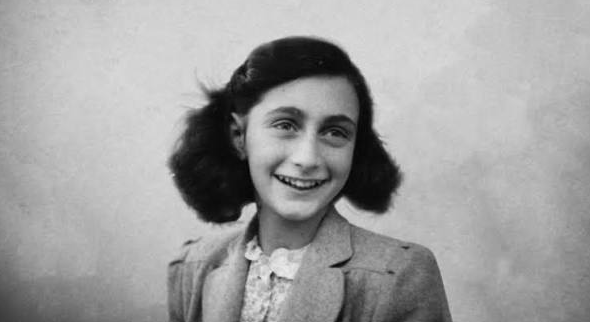
Anne Frank was a Jewish girl whose life was cut short in the Holocaust. During World War II, her family went into hiding in Amsterdam to escape the Gestapo. In the cramped, secret rooms above her father’s business, Anne started keeping a diary. She wrote about everything—her daily routine, her private thoughts, the tension of living in fear. After the war, Anne’s father, Otto Frank, was the only family member to survive. When he discovered her diary, he was struck by how much depth and maturity her writing carried. He got it published, first as ‘Diary of a Young Girl’ and later as “The Diary of Anne Frank.” Since then, Anne’s diary hasn’t just become one of the best-known accounts of the Holocaust—it’s also put a face, a voice, a human story behind the overwhelming numbers.
“It’s difficult in times like these; ideals, dreams and cherished hopes rise within us, only to be crushed by grim reality. It’s a wonder I haven’t abandoned all my ideals, they seem so absurd and impractical. Yet I cling to them because I believe, in spite of everything, that people are truly good at heart.” —Anne Frank, July 21, 1944
Anne Frank Biography
Anne was born on June 12, 1929, in Frankfurt, Germany. Her father, Otto, worked as a businessman in the city. When Adolf Hitler rose to power in 1933, bringing a wave of antisemitic laws, Otto moved his family to the Netherlands for safety. There, he started a new business, selling pectin for making jam.
But things didn’t stay safe for long. In 1940, Nazi forces invaded Holland, and the restrictions on Jewish people stacked up fast. Anne had to switch from her public school to a separate Jewish one. Life kept shrinking, as she wrote in her diary:
“After May 1940…the trouble started for the Jews. Our freedom was severely restricted by a series of anti-Jewish decrees: Jews were required to wear a yellow star; Jews were required to turn in their bicycles; Jews were forbidden to ride trams or in cars, even their own…Jews were forbidden to go to theatres, cinemas or any other forms of entertainment; Jews were forbidden to use swimming pools, tennis courts, hockey fields or any other athletic fields…You couldn’t do this and you couldn’t do that, but life went on…” —Anne Frank, June 20, 1942
By 1942, the situation was getting worse. When Anne’s older sister was threatened with deportation, her father decided they had to disappear. The family hid in secret rooms behind his company building, right in the middle of Amsterdam. Soon, they were joined by the Van Pels family, also hoping to escape arrest. Friends like Miep Gies risked everything to bring them food and supplies. If anyone had discovered them, the consequences would have been fatal.
Forced Into Hiding
Anne was thirteen when they moved into hiding. In the secret annex, with so many people packed together and no safe way to get outside, tempers frayed and nerves wore thin. Even little annoyances could cause big arguments. But Anne found a small escape in her writing. She poured her frustrations, hopes, and dreams into her diary. She also wrote about her first crush—Peter van Pels, who was also hiding nearby. They shared a kiss, but Anne wondered if she really loved him, or if it was just loneliness and the strangeness of their situation.
Even when things looked bleak, Anne refused to give up her sense of hope. She wrote:
“I long to ride a bike, dance, whistle, look at the world, feel young and know that I’m free, and yet I can’t let it show. Just imagine what would happen if all eight of us were to feel sorry for ourselves or walk around with the discontent clearly visible on our faces. Where would that get us?” —December 24, 1943
But on August 4, 1944, someone betrayed them. The German secret police raided the annex and arrested everyone, plus two of their helpers. The group was sent to Auschwitz on the last convoy out of the Netherlands. Most children under 15 went straight to their deaths, but Anne, just old enough, was sent to a labor camp for women. A few months later, she and her sister Margot were transferred to Bergen-Belsen, a place notorious for its awful conditions. Food was scarce, disease spread quickly, and guards abused the prisoners. In the final winter before liberation, Anne became sick with typhoid and died—just weeks before the camp was freed.
Everyone in Anne’s family died in different camps except for her father, Otto. After the war, he returned to the annex and found Anne’s diary. He knew his daughter had dreamed of being a writer, so he made sure her story saw the light of day. The original Dutch version was called Het Achterhuis (“The Secret Annex”), but when translated into English, it became “The Diary of Anne Frank.”
The Diary
The diary came out in 1947—just 3,000 copies at first—but after a glowing newspaper review, it became a bestseller and has now been translated into over 60 languages. Readers felt like they knew Anne. Her words made the loss of millions feel heartbreakingly personal. “One voice speaks for six million—the voice not of a sage or a poet but of an ordinary little girl,” wrote Soviet author Ilya Ehrenburg.
Anne Frank’s writing has become both a memorial and a warning—proof of how easy it is for hate to destroy innocent lives, and a reminder that even in terrible times, some people never lose their hope. Since 1960, the small rooms where Anne’s family hid have been preserved as the Anne Frank Museum. Each year, thousands visit, still moved by her words and what she stands for.
As Eleanor Roosevelt put it, “One of the wisest and most moving commentaries on war and its impact on human beings that I have ever read.” Anne’s story shines a light on the millions lost, and the futures cut tragically short.
About the Author