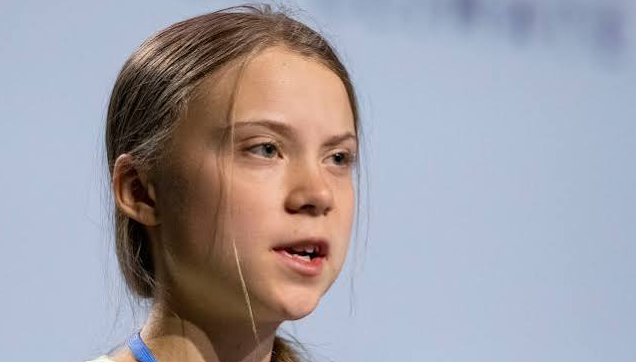
Greta Thunberg is a Swedish activist best known for her outspoken stance on climate change. She stepped into the spotlight back in 2018, just 15 years old, when she started protesting outside the Swedish Parliament. It started as a solo effort—a one-person school strike for the climate—but pretty soon, her protest caught fire. Kids from all over the world joined in, and suddenly, Greta became the face of a new generation of environmental activism.
She’s traveled all over (never by airplane—she’s serious about her carbon footprint) to speak with world leaders, demanding immediate action on climate change. Greta always says she’s not tied to any political party. She just believes we have to act now if we want to avoid a disaster. She doesn’t mince words either—at one event, she told a packed room, “Our house is on fire… We are less than 12 years away from not being able to undo our mistakes.”
Greta Thunberg Biography
Greta was born on January 3, 2003. Her mom’s an opera singer, her dad’s an actor. She learned about the dangers of global warming when she was eight and couldn’t believe adults weren’t doing more about it. As she grew more aware, the lack of action actually made her deeply depressed; she went quiet for long periods, a condition called ‘selective mutism.’ She was also diagnosed with Asperger syndrome—she’s open about it and says it makes her see things very clearly, especially when it comes to right and wrong.
School wasn’t easy for Greta. She was shy, hated small talk, and spent a lot of time alone. But as it turns out, those traits helped her become a clear, persistent voice in a noisy world. She says that speaking out about climate change was the one thing that helped pull her out of depression. She’s relentless—she admits she just can’t let things go, and that quality helped her wear down her parents, too. Greta flooded them with arguments and stats until she convinced them to change their own habits.
When she won an environmental essay contest in May 2018, things really started moving. She connected with Fossil Free Dalsland, a Swedish environmental group, and decided to launch her own school strike for climate action. She actually got the idea from American students who staged a walkout after the Parkland school shooting.
Funny thing—when Greta decided to strike, none of her friends wanted to join her. So, she just went alone, sitting outside the Parliament on August 20, 2018, with her homemade sign. That summer, Sweden was suffering from severe heatwaves and fires, yet politicians shrugged it off. Greta announced she wouldn’t return to school until after the September elections unless the government promised to cut carbon emissions as agreed in the Paris Climate Accord. At first, she looked like just a solitary teenager on the city’s cobblestones. Even her parents tried to talk her out of it.
She didn’t back down, though. After the election, she kept skipping school every Friday to strike, always catching up on her homework later. Her grades stayed strong—her dad says she was still top five in her class. Greta’s commitment, and her blend of activism with her studies, is intense—she puts in 12-15 hour days. When her protest started spreading on social media, kids in other countries joined. The movement exploded, and suddenly, school strikes for the climate were front-page news.
People are split about these strikes. Supporters say the stakes are just too high to play by the old rules. Even the UN Secretary General, Antonio Guterres, admitted that his generation failed to meet the challenge. Critics, though, accuse Greta of encouraging kids to skip school for nothing.
Values
Greta’s serious about living her values. She’s vegan, and she pushed her parents to go vegan too—she told them they were hurting her generation every time they ate meat. She flat-out refuses to fly, which has given rise to the idea of “flight shame”—the notion that we should feel guilty for choosing planes over lower-carbon travel.
She’s addressed leaders at huge events like Davos, the European Parliament, and the Austrian World Summit. At Davos, she arrived by train while others showed up in private jets and didn’t hold back—she called out world leaders for sacrificing the planet for profit.
In the summer of 2019, Greta made headlines again when she decided to cross the Atlantic to the UN Climate Summit in New York by high-speed racing yacht, powered by solar panels and underwater turbines—zero emissions the whole way. She planned to continue to another conference in Chile, traveling by train with her dad, taking a year off school to focus on activism.
She’s found creative ways to get her message out, too. She collaborated with the band The 1975, recording a spoken-word track calling for civil disobedience to spark real change.
Her impact is hard to ignore. Greta was nominated for the Nobel Peace Prize and named one of Time’s 100 most influential people in the world in 2019.
The Controversies
Of course, stepping into the spotlight brought backlash. Politicians, climate deniers, and even President Trump have mocked and criticized her, sometimes attacking her personally. Greta shrugs it off, saying hate is a sign of progress—“they see us as a threat… we are making a difference.”
Her fame has only complicated things. She calls it surreal—sometimes she feels like two different people, one quiet and anonymous, the other world-famous. Still, Greta refuses to profit from her work. She doesn’t take money for speeches, and when she discovered a company was using her name for financial gain, she cut ties immediately. She’s careful to remind everyone that she’s not a scientist—she’s simply amplifying what experts have been shouting about for years.
And “the Greta effect” is real. She’s inspired massive waves of youth climate action all over the globe. When she turned up in Bristol, 25,000 people joined her to protest for the future.
Through it all, Greta’s message stays loud and clear: we don’t have much time, but we can still turn things around—if we stop waiting and finally act.
About the Author